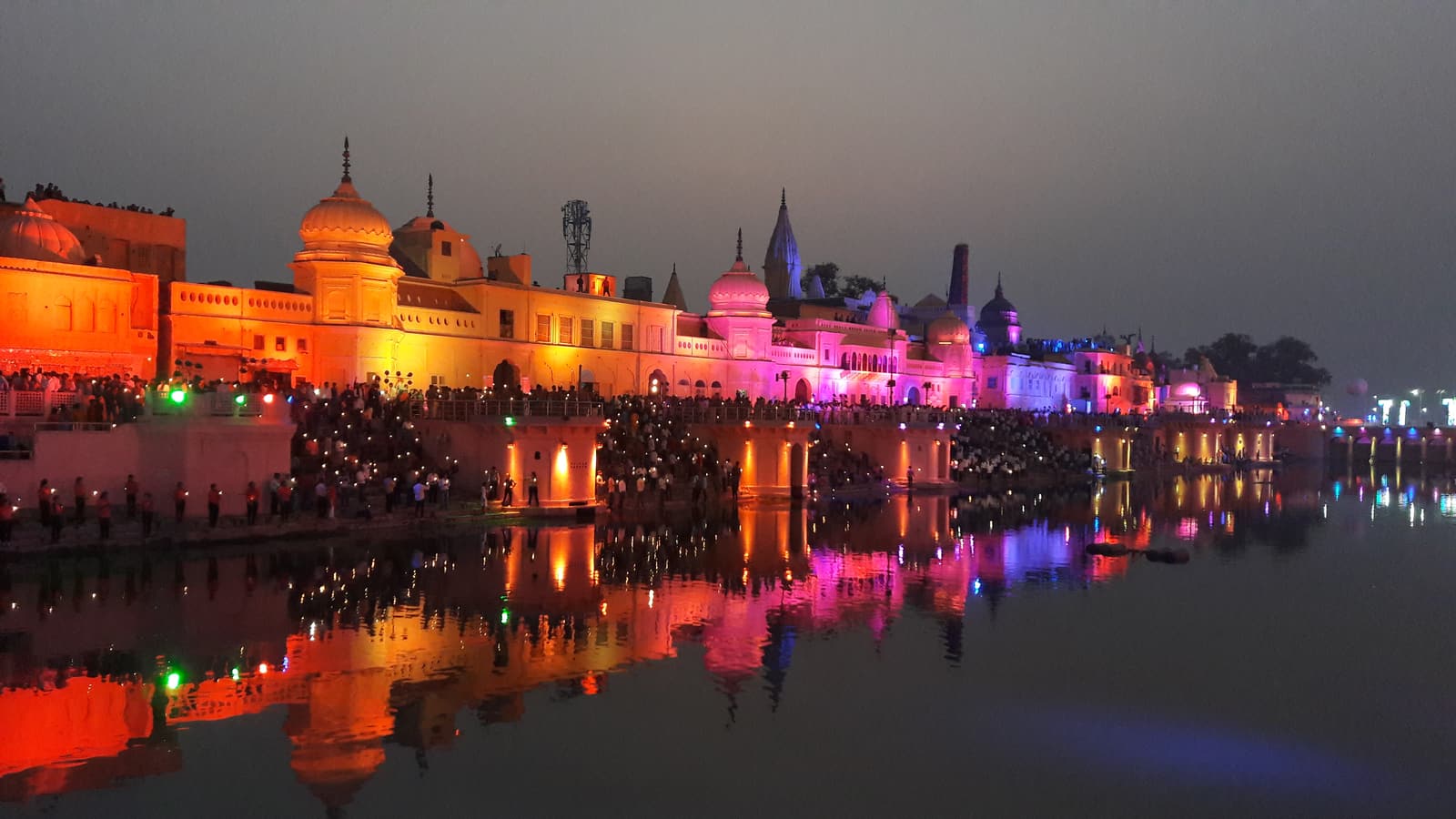
A visit to the Ram Mandir is simple once you know the sequence: leave your phone and bag in a locker, pass through security, walk the approach path, climb to the temple, have darshan of Ram Lalla in the sanctum and leave by the exit route, where prasad is usually handed out. On an ordinary weekday the whole thing can take about an hour; on weekends and festivals it can take several.
Typical daily schedule
The table shows the pattern that has generally been followed since the temple opened. Treat every time as approximate: the trust adjusts the schedule between summer and winter and on festival days.
| Part of the day | Approximate time | What to know |
|---|---|---|
| Mangala Aarti | Around 4:00–4:30 am | The first aarti of the day; entry by aarti pass only |
| Shringar Aarti | Around 6:00–6:30 am | Entry by aarti pass; general darshan starts afterwards |
| Morning darshan | From about 6:30–7:00 am until around midday | Usually the calmest hours, especially on weekdays |
| Bhog Aarti and midday pause | Around 12:00 noon | Darshan pauses briefly while the offering is made |
| Afternoon and evening darshan | From early afternoon to about 9:00–9:30 pm | Busiest in the late afternoon and on weekends |
| Sandhya Aarti | Around 7:00–7:30 pm | Evening aarti; darshan may be held briefly |
| Shayan Aarti | Around 9:30–10:00 pm | The last aarti; entry by aarti pass, then the temple closes |
Is there a ticket? Passes explained
General darshan needs no ticket and no booking. You simply join the queue. In addition, the trust has offered a limited number of free passes through its own website and at a counter near the temple:
- Sugam Darshan / special darshan passes — free passes for a fixed time slot that use a shorter entry lane. Names, slots and quotas have changed more than once, so check what is currently offered.
- Aarti passes — free passes to attend the Mangala, Shringar or Shayan aarti. Numbers are small and are usually booked out well ahead.
Passes are issued against a government photo ID, which you must carry on the day, and they are not transferable. There is no charge. Anyone offering paid “VIP darshan” is not acting for the trust.
Security rules: what you cannot take in
Security is airport-style and strict. Under the rules in force at the time of writing, you may not carry:
- Mobile phones, smart watches, cameras, earphones, power banks or any other electronics
- Bags, backpacks and large purses
- Remote car keys, lighters, matchboxes, tobacco and sharp objects
- Food and drink from outside; leather belts and wallets have also been restricted at times
Free lockers and cloakrooms are provided at the Pilgrim Facilitation Centre near the entrance, with separate counters for footwear. Queues for lockers can be long at peak hours, so the easiest approach is to leave everything except your ID, a little cash and any pass at your hotel. Photography inside the complex is not possible because phones and cameras are not permitted.
The route, step by step
- Reach the entry. Pilgrims enter from the Ram Path side along the Ram Janmabhoomi Path. Vehicles are stopped well short of it; expect to walk or take an e-rickshaw for the last stretch.
- Deposit belongings and footwear at the facilitation centre.
- Security check with frisking and metal detectors.
- Walk to the temple and climb the steps on the eastern side (a ramp and lifts are provided for those who need them).
- Darshan of Ram Lalla from the hall in front of the sanctum. The line keeps moving, so you will have a short time in front of the deity.
- Exit by the marked route and collect your belongings.
What to wear
No formal dress code has been enforced for general darshan, but modest clothing is expected: shoulders and knees covered, nothing tight or revealing. Traditional Indian dress is common and always appropriate. You will walk barefoot on stone, which is very hot in summer afternoons and cold on winter mornings — socks are usually allowed and help a great deal.
How to shorten the queue
- Come on a weekday, and avoid Tuesdays and Saturdays if you also plan to visit Hanuman Garhi, which is busiest on those days.
- Be at the entry soon after general darshan opens, or come after the evening aarti.
- Avoid Ram Navami, Deepotsav, the weeks around 22 January, long weekends and school holidays unless you are coming specifically for them.
- Travel light so you can skip the locker queue.
- Drink water before you join the queue; drinking water and toilets are available along the route.
Elderly visitors and accessibility
The trust provides free wheelchairs, usually with a volunteer or attendant, from the facilitation centre, and the temple has a ramp and lifts. Golf-cart style electric vehicles have operated on the approach roads for elderly and disabled pilgrims. Availability is limited at busy times, so arrive early and ask at the help desk. The walk from the drop-off point to the sanctum and back is still considerable — plan rest stops.
Prasad, donations and offerings
Prasad is normally distributed free on the exit route. Donations are entirely voluntary and should be made only at the trust’s official counters or through its official website. Flowers, sweets and other offerings from outside have generally not been allowed into the sanctum.
The temple itself
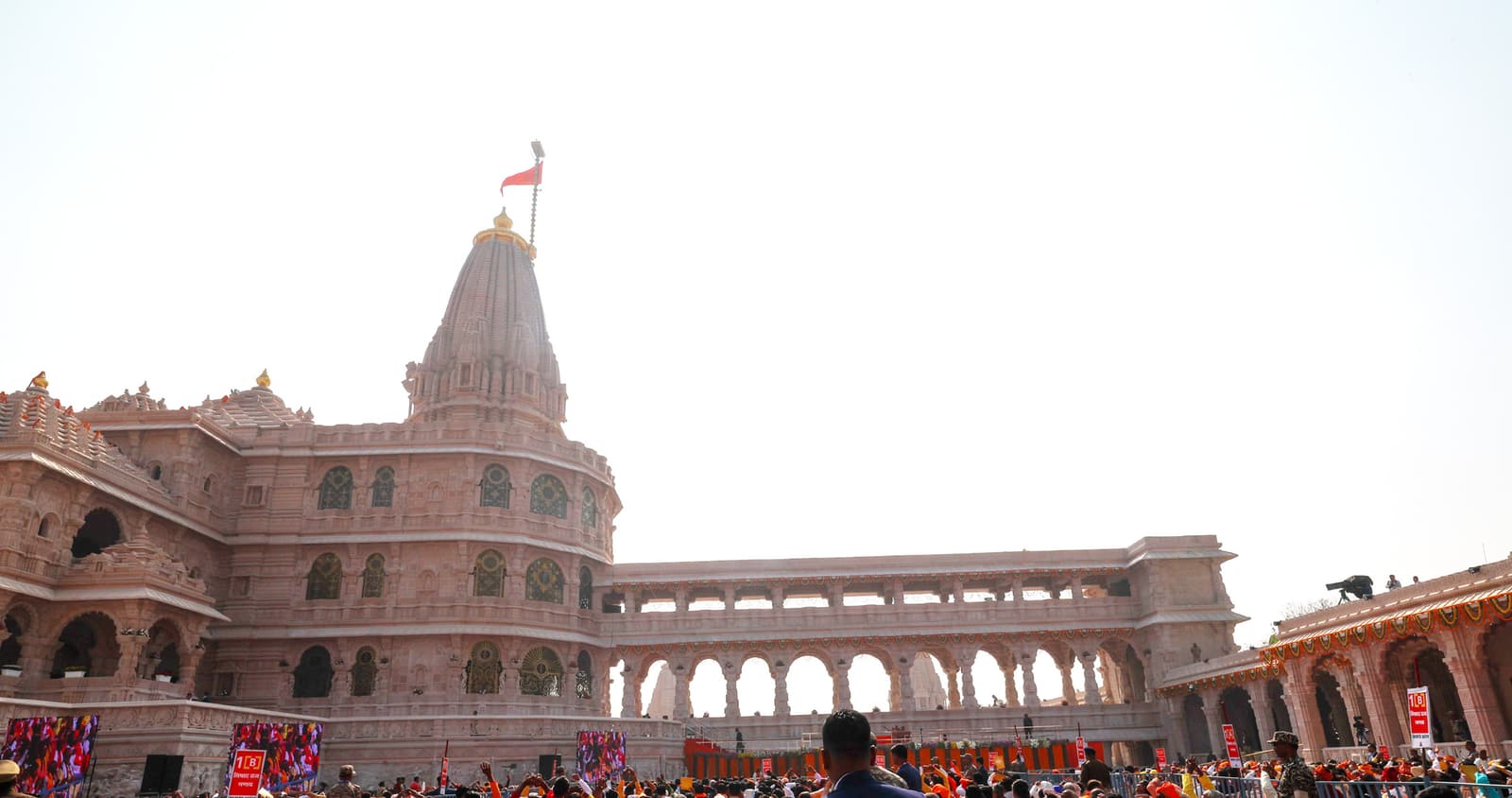
The Ram Mandir is built in the Nagara style of north Indian temple architecture, in pink sandstone from Rajasthan, to a design by the Sompura family of temple architects. According to the trust, the temple is about 380 feet long, 250 feet wide and 161 feet high, with three storeys, 392 pillars and 44 doors, and was built without iron or steel. The sanctum holds Ram Lalla — Lord Ram as a five-year-old child — carved in dark stone by the Mysuru sculptor Arun Yogiraj and consecrated on 22 January 2024. Work on the upper floors, the spire and the surrounding shrines continued in phases after that date, so parts of the complex may still be opening gradually. Read more on the Ram Mandir page.